

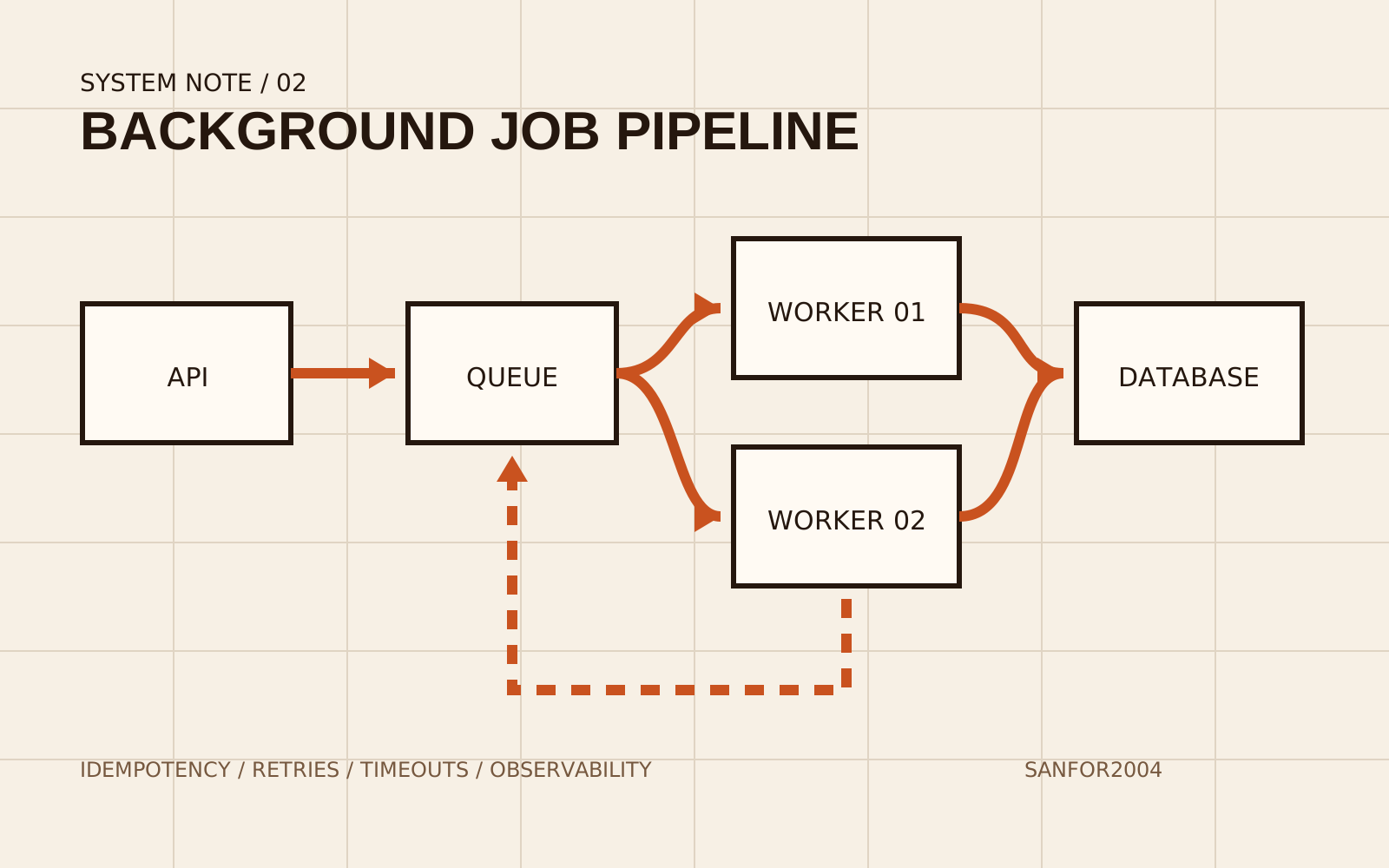
Background jobs begin as a simple idea: move slow work away from the request that triggered it. An API accepts an action, places a message on a queue, and allows a worker to finish the operation later. That separation makes the user-facing request faster, but it also introduces a second system with its own timing, failure modes, and operational responsibilities.
A reliable job pipeline is therefore not just a queue and a worker. It is a contract covering delivery, ownership, retries, duplication, observability, and recovery. The design has to explain what happens when a worker crashes after writing data, when a dependency responds slowly, when the same message arrives twice, and when a malformed job can never succeed.
Begin With the Job Contract
Every job should describe one specific unit of work. The payload needs a stable identifier, a version, the minimum data required to perform the operation, and enough context to trace it back to the originating request. Large mutable objects should usually stay in the database; the message can carry the record identifier and let the worker read the current state.
A useful envelope might contain a job ID, job type, schema version, creation time, correlation ID, attempt count, and payload. The envelope remains consistent across job types while the payload changes according to the work being performed. This makes validation, logging, and future migrations much easier.
Validation should happen before a message enters the main queue and again when a worker receives it. The first check prevents obviously invalid work from spreading. The second protects workers from old messages, accidental manual publications, and producers that have not yet been updated.
Delivery Is Usually At Least Once
Many queues provide at-least-once delivery. A worker can complete an operation and crash before acknowledging the message, causing the queue to deliver that message again. Treating duplication as an unusual edge case leads to duplicated emails, repeated payments, incorrect counters, and confusing audit trails.
The safer assumption is that every job may run more than once. An idempotency key gives the system a stable way to recognize the same logical operation. Before performing a sensitive side effect, the worker checks whether that key has already completed. The check and state change should be protected by a database constraint or transaction, rather than a read followed by an unprotected write.
Idempotency does not mean silently ignoring every repeated request. It means producing the same final state when the same operation is delivered again. The worker should return the earlier result when possible and record that the duplicate was handled intentionally.
Make Retries Deliberate
Retries are useful for temporary failures such as network interruptions, rate limits, unavailable dependencies, and short database outages. They are harmful when applied without limits to invalid input, missing permissions, incompatible schemas, or permanent business-rule failures.
Classify errors into retryable and terminal groups. Retryable failures should use exponential backoff with jitter so that many workers do not attack a recovering dependency at the same moment. Terminal failures should move directly to a dead-letter queue or failed-job store with a clear reason.
The maximum attempt count should reflect the job’s value and urgency. A time-sensitive notification may become irrelevant after an hour, while an accounting reconciliation can remain useful for days. Attempt count alone is not enough; an expiration time helps the worker decide when delayed work is no longer worth completing.
Control Concurrency and Backpressure
Adding workers increases throughput only until the downstream systems become the bottleneck. Too much concurrency can exhaust database connections, trigger vendor rate limits, saturate CPU, or create lock contention. Worker count should follow measured capacity rather than queue length alone.
Use separate queues when workloads have different priorities or resource profiles. A large image-processing job should not block a short password-reset email. A critical payment workflow should not compete equally with optional analytics. Queue separation also makes it easier to apply different retry, timeout, and concurrency policies.
Backpressure is the system’s ability to slow down safely. Producers may need rate limits, batching, or admission control when the queue grows beyond an agreed threshold. Without a plan, the queue can become a storage system for work that the application has no realistic capacity to finish.
Timeouts Need More Than One Layer
Each external operation should have its own timeout, and the full job should have an overall deadline. Without operation-level timeouts, one dependency can occupy a worker indefinitely. Without a job-level deadline, a chain of individually acceptable waits can still exceed the time in which the result is useful.
Timeouts should lead to cancellation where the underlying client supports it. Otherwise, the timed-out operation may continue consuming sockets or database work even after the worker has moved on. When cancellation is impossible, concurrency limits become even more important.
Observability Is Part of the Feature
Operators need to answer a few questions quickly: how many jobs are waiting, how old is the oldest job, how long do jobs take, which job types fail, and how many attempts are required before success? Queue depth without queue age can be misleading; a healthy burst may create a large queue that drains quickly, while a small queue containing very old work can indicate a serious problem.
Structured logs should include the job ID, correlation ID, type, attempt, duration, result, and relevant dependency status. Metrics should measure throughput, latency, retries, terminal failures, dead-letter growth, and worker saturation. Traces are valuable when a job is part of a longer request that crosses services.
Alerts should represent user or business impact. A single failed attempt is rarely urgent if retries are working. A growing oldest-job age, exhausted retries for a critical job type, or a dead-letter queue increasing continuously deserves attention.
Plan the Recovery Workflow
A dead-letter queue is not a solution by itself. Someone needs a safe way to inspect failed jobs, understand why they failed, correct the underlying issue, and replay selected messages. Replaying everything at once can recreate the original incident or overload a dependency that has only just recovered.
Recovery tools should support filtering by job type, failure reason, time range, and correlation ID. Replays should create an audit record and retain the original job identity. For dangerous operations, a dry-run mode can validate whether a replay would be accepted without performing the side effect.
Test the Failure Paths
The happy path proves that the worker can run. Reliability tests prove that the system can recover. Useful tests include delivering the same job twice, crashing after a database write but before acknowledgement, timing out an external API, exhausting all retries, pausing workers while producers continue, and replaying a failed job after a schema change.
Load tests should measure more than jobs per second. Watch database connection usage, CPU, memory, queue age, external rate limits, and the time required to return to normal after a burst. A system that accepts work faster than it can recover is not stable simply because the queue never rejects a message.
A Practical Launch Checklist
Before production, confirm that each job has a validated and versioned payload, a stable idempotency strategy, explicit timeouts, classified errors, bounded retries, and a dead-letter destination. Document concurrency limits and dependency capacity. Add dashboards for queue age and failure rate. Finally, test replay with real operational tooling rather than assuming messages can be copied back manually during an incident.
The main lesson is simple: moving work to the background does not remove complexity. It relocates complexity into a system that must be designed and operated deliberately. A queue becomes reliable when its failure behavior is as carefully defined as its success path.